Long bond paper is a popular paper size used in the Philippines and other parts of the world. It offers a range of advantages over other paper sizes and is widely used for various purposes. In this article, we will explore everything you need to know about long bond paper size, including its uses, dimensions, advantages, and printing guide.
Despite the growing use of digital documents and cloud storage, paper documents remain essential in many offices, schools, government agencies, and courts throughout the Philippines. Many institutions continue to require printed copies of contracts, reports, affidavits, certificates, research papers, and application forms. Because of this, understanding the correct paper size is important to ensure documents meet formatting requirements and print correctly. Using the wrong paper size can lead to clipped margins, incorrect page breaks, and formatting issues, especially when submitting official documents.
Uses of Long Bond Paper
Long bond paper is commonly used in schools, law offices, and other private agencies. It is widely used for printing documents, such as contracts, legal papers, business letters, and academic papers. Its length and width make it suitable for printing forms, and other official documents. It is also used in printing books, manuals, and other lengthy documents that require multiple pages.
For many years, the Philippine government utilized long bond paper for its official documentation. However, on August 1, 1986, Joint Memorandum Circular No. 1, s. 1986 was released, announcing that the government would be standardizing the size of writing paper used for all official communication and purposes. The use of long and short bond paper (8” x 13” and 8” x 10.5”, respectively) was no longer permitted, and instead, the government would be adopting the A4 size (210 mm x 297 mm), which is a metric measurement. This decision was made in compliance with various laws and regulations pertaining to standardization and the use of metric measurements in the Philippines, with the ultimate objective of promoting consistency and efficiency in government communications and processes.
Aside from legal documents and school requirements, long bond paper is also widely used for resumes, certificates, payroll reports, invoices, employee records, engineering plans, and business proposals. Many government agencies and private companies still request documents to be submitted on long bond paper because it provides additional writing and printing space compared to shorter paper sizes. It is likewise a popular choice for photocopying multi-page documents that require larger margins or additional room for signatures and official stamps.
Dimensions of Long Bond Paper
The standard dimensions of long bond paper in centimeters (cm) are 21.59 x 33.02 cm or 8.5 x 13 inches. In millimeters (mm), it measures 215.9 x 330.2 mm, and in pixels, it measures 2550 x 3900 pixels. The long bond paper is longer than the standard A4 paper size, making it more suitable for printing long documents.
Because computer applications use different measurement systems, it is helpful to know the equivalent dimensions in various units. Most word processors allow users to enter paper dimensions manually using inches, centimeters, or millimeters. Meanwhile, graphic design software often measures paper size in pixels, with the exact pixel dimensions depending on the selected print resolution or DPI (dots per inch). For high-quality printing at 300 DPI, long bond paper measures approximately 2550 × 3900 pixels.
Advantages of Using the Long Bond Paper
One of the main advantages of long bond paper is its length. It allows for printing longer documents without the need for stapling or binding multiple pages together. Additionally, it offers more space for printing tables, charts, and graphs, making it a suitable option for business and academic documents. It also has a professional look and feel, which is ideal for official documents.
Another advantage is improved document readability. Since the paper is longer, users can fit more content on each page without significantly reducing the font size or narrowing the margins. This can reduce the total number of pages in lengthy reports, making documents easier to organize, print, and bind. For organizations that frequently produce contracts or technical documents, this can also help minimize paper consumption and improve overall document presentation.
Printer Compatibility
Before printing on long bond paper, verify that your printer supports the 8.5 × 13-inch paper size. Most modern inkjet and laser printers support legal-size or long bond paper, but some compact home printers only accommodate A4 or Letter-sized paper. If your printer does not support long bond paper, you may need to adjust your document layout or print using another printer with a larger paper tray.
It is also advisable to check your printer preferences before printing. Make sure that both the paper size selected in Microsoft Word and the paper size configured in your printer driver match exactly to avoid scaling problems or cut-off margins.
How to Set the Long Bond Paper Size in MS Word
If you’re looking to print a document on long bond paper, you may find that Microsoft Word doesn’t automatically offer this option. This can be frustrating, especially if you’re working on an important project that requires specific paper size requirements. Fortunately, setting up a long bond paper format in Microsoft Word is relatively easy. In this guide, we’ll take you through the steps to set up the long bond paper in Microsoft Word, so you can print your documents with confidence.
To set up the long bond paper size in Microsoft Word, follow these steps:
Step 1: Open Microsoft Word and create a new document. Click on the “Page Layout” tab at the top of the screen.
Step 2: Click on the “Size” button, which is located in the “Page Setup” group.
Step 3: Scroll down the list of paper sizes and choose the 8.5″ x 13″ option. If you cannot find it, scroll down and select “More Paper Sizes.”
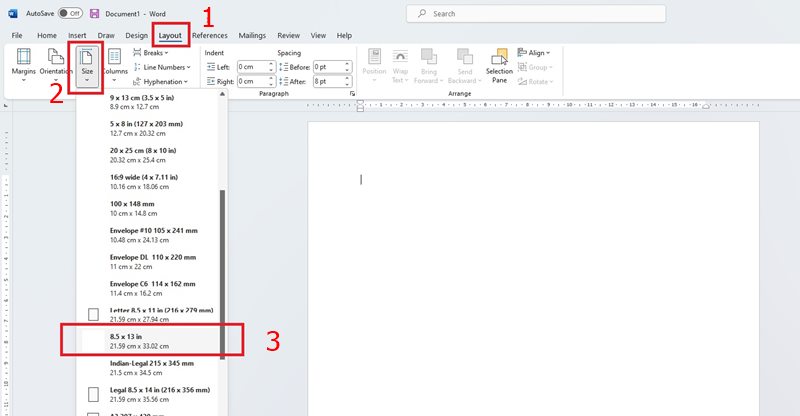
Step 4: Your document will now be set up for long bond paper format. You can start typing or formatting your document as you normally would. If you frequently use long bond paper, you can save the document as a template so you won’t need to configure the paper size every time you create a new document. Simply save the file as a Word Template (.dotx), and future documents will automatically use the correct page dimensions.
Once you’ve set up your document for long bond paper, you can print it just like any other document. However, it’s important to ensure your printer can accommodate this paper size before attempting to print. If your printer doesn’t support long bond paper size, you may need to adjust the paper size or use a different printer.
Long Bond Paper vs A4 Size
The table below highlights the main differences between long bond paper and A4 paper.
| Feature | Long Bond Paper | A4 Size |
|---|---|---|
| Size | 8.5 x 13 inches | 8.27 x 11.69 inches |
| Orientation | Landscape or Portrait | Portrait |
| Common Uses | Legal Documents, Reports | Letters, Documents, Notes |
| Availability | Commonly available | Commonly available |
| Print Capacity | Higher | Lower |
| Folding Capacity | More difficult to fold | Easier to fold |
| Standardization | Not an international standard | An international standard |
| Cost | Generally more expensive | Generally less expensive |
| Weight | Heavier | Lighter |
Long bond paper, also known as legal-sized paper, is bigger than A4 paper and is often used for legal documents and reports. A4 is the standard paper size used in most countries for letters, documents, and notes.
The long bond paper can be used in either landscape or portrait orientation, while A4 paper is primarily used in portrait orientation. The former has a higher print capacity than the latter due to its larger size. However, it is more difficult to fold and may not fit into standard file folders.
While A4 paper is an international standard, long bond paper is not. As a result, it may be more challenging to find it in some countries. It is generally more expensive than A4 paper due to its larger size and lower demand.
In terms of weight, long bond paper is heavier than A4 paper. This can make it more durable, but it can also make it more challenging to carry and store.
One reason A4 has become the global standard is its inclusion in the ISO 216 paper size system, which is used by most countries around the world. Because of this international standardization, printers, photocopiers, folders, envelopes, and filing systems are generally designed around A4 dimensions. Long bond paper, meanwhile, remains widely used in the Philippines, the United States (Legal size), and several other countries for legal and administrative documents that require additional page length.
Overall, the choice between long bond paper and A4 paper will depend on the user’s specific needs. Those requiring larger print capacity or more durable paper may prefer long bond paper, while those needing a standard size for everyday use may prefer A4 paper.
Conclusion
Although many organizations have transitioned to digital documents, long bond paper continues to play an important role in schools, businesses, law offices, and government agencies throughout the Philippines. Understanding its correct dimensions, advantages, and proper formatting can help ensure that your documents meet official requirements and maintain a professional appearance. Whether you’re preparing a legal contract, research paper, business report, or school requirement, using the correct paper size helps prevent printing errors and formatting issues. By familiarizing yourself with the differences between long bond paper, A4, and other paper sizes, you’ll be better equipped to create documents that are both accurate and professionally presented.